Supplier data: the silent complexity that costs you dearly

Quotes, Unit Price Schedules, Price Breakdowns, invoices, framework contracts, price lists. Why supplier document volume has become the biggest blind spot in procurement performance ?
Ten years ago, a buyer managed a few dozen suppliers, an Excel spreadsheet and contracts signed in duplicate. Today, that same buyer juggles hundreds of references, dozens of different document formats, variable pricing conditions and accumulating regulatory obligations. Supplier data has exploded. Its complexity, however, has remained largely invisible and that is precisely what makes it so costly.
When supplier data became unmanageable
The growth of supplier data is not a recent phenomenon, but its acceleration is brutal. Three converging factors explain why the situation has reached a breaking point for the majority of procurement functions.
The explosion in the number of suppliers and references
The globalisation of supply chains, the increasing specialisation of service providers and the fragmentation of markets have mechanically multiplied the number of active suppliers within organisations. A mid-sized company now deals on average with several hundred distinct suppliers. A large group may manage several thousand. Each one produces its own documents (quotes, purchase orders, delivery notes, invoices, amendments…) in its own format, with its own formalism, its own item codes, its own descriptions.
The result is mechanical: where a procurement department once processed a few dozen documents per week, it now processes hundreds. And each of those documents must be read, interpreted, compared against one or more reference frameworks, then validated or disputed. The volume of data to process has grown far faster than the headcount responsible for managing it.
The proliferation of document formats and formalisms
What makes this growth particularly difficult to absorb is not just the volume, it is the heterogeneity. Supplier data arrives in dozens of different formats, often unstructured and rarely standardised.
A quote may be presented as an Excel table, a free-form PDF, a manually formatted Word document, or even a summary email. A Unit Price Schedule (UPS) follows public sector conventions, but each administration produces its own version. A Global and Fixed Price Breakdown (GFPB) may contain hundreds of lines with codes, units and conditions specific to each contract. Price lists set out prices subject to variation rules indexed to official benchmarks that evolve independently of contractual commitments.
Faced with this heterogeneity, any attempt at manual or semi-automated processing hits the same wall: it is impossible to directly compare what has not been put into the same format. Before even detecting a discrepancy, the data must be normalised and the data refuses to normalise itself.
Regulatory pressure as a complexity accelerator
The third force aggravating the situation comes from outside: the intensification of regulatory obligations. The CSRD (Corporate Sustainability Reporting Directive), the CS3D (Corporate Sustainability Due Diligence Directive) and the general tightening of traceability requirements oblige companies to document not only what they buy and at what price, but also from whom, under what conditions and with what consequences for their value chain. Each supplier thus becomes a source of data to be qualified, monitored and documented over time.
The invisible cost of unmanaged complexity
The complexity of supplier data has a cost. But this cost is rarely measured, because it is diffuse, spread across multiple functions, and above all invisible on balance sheets. It nonetheless manifests in three concrete and quantifiable forms.
The time cost: hours spent on time-consuming tasks with no strategic value
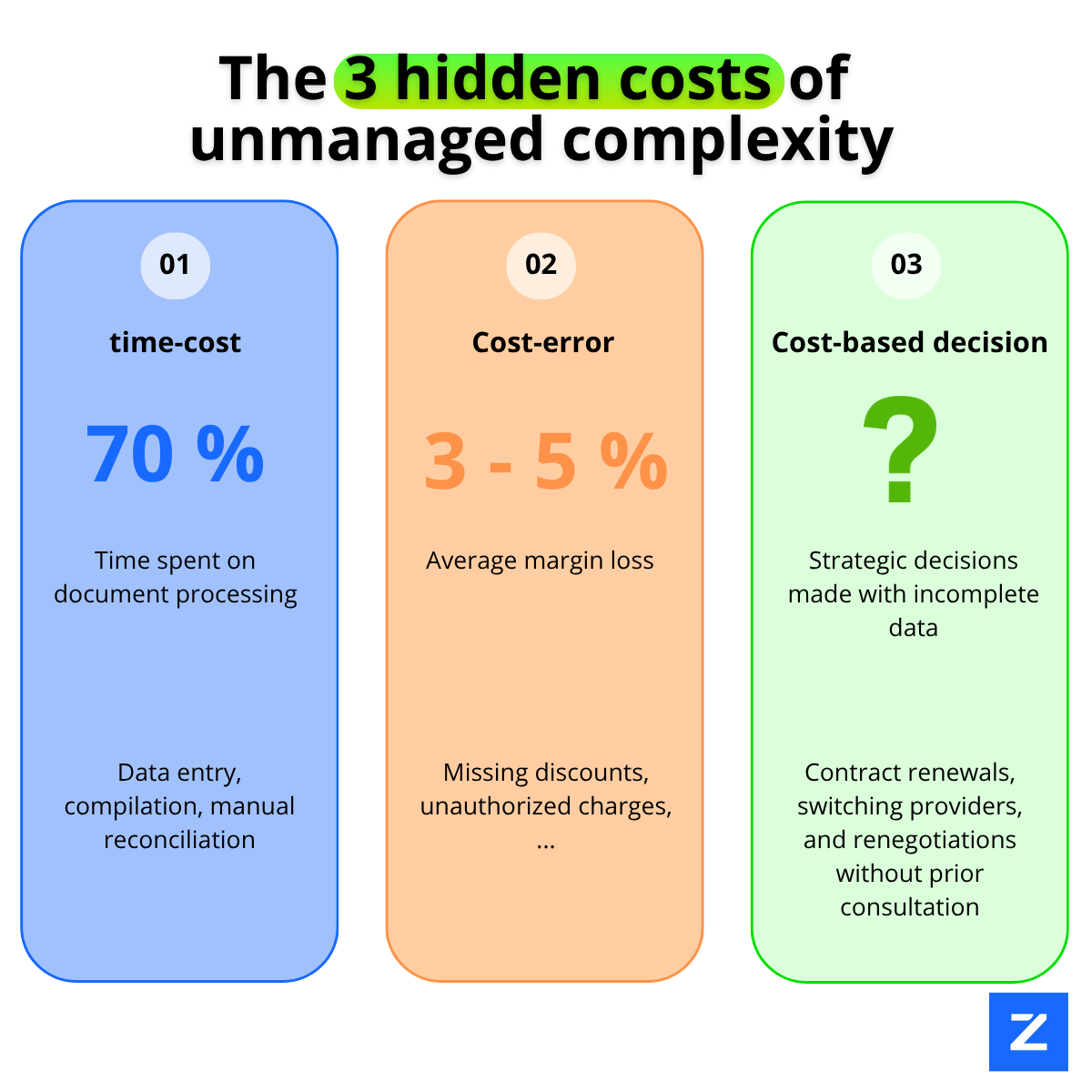
The first consequence is the most obvious, but the least well measured. In most organisations, between 40% and 70% of a buyer's time is absorbed by document processing tasks: compiling quotes, re-entering billing data, attempting to manually reconcile documents that do not share the same format. This is not time spent on negotiation, supplier monitoring or building partnerships. It is data entry and mechanical verification time, paid at the price of an expert.
The reality is even more stark on complex files. A buyer who receives an invoice linked to a construction contract with a 400-line Unit Price Schedule may spend several hours on it before validating or disputing it. Multiply that by the number of weekly invoices, by the number of buyers in the organisation, and the scale of the problem becomes clear.
The error cost: overbilling that flies under the radar
The second consequence is financial and often staggering when measured for the first time. In any significant billing volume, a portion of received invoices contains anomalies relative to the negotiated conditions. These anomalies are not necessarily fraudulent: they most often result from configuration errors, price updates not passed through, ancillary charges added out of habit rather than agreement, or divergent interpretations of contractual clauses.
A 12% discount secured after three months of negotiation disappears from the next invoice. A unit price slightly above the contractual rate has been applied across several deliveries without anyone noticing. On an isolated invoice, each discrepancy is marginal. Over a year, across all suppliers, across a network of several dozen sites, these discrepancies represent several margin points lost in silence.
With our clients, initial ZYLIO analyses systematically reveal billing errors in a significant proportion of the documents processed, discrepancies that, without the right tool, would never have been detected. Scaled against an annual procurement budget of several million euros, these discrepancies represent tens of thousands of euros in silent overbilling.
The decision cost: strategic choices made without reliable data
The third consequence is perhaps the most serious in the long term, because it is the least visible. When supplier data is scattered, non-normalised and uncompared, strategic procurement decisions (renewing a contract, changing supplier, renegotiating pricing, consolidating volumes) are made on the basis of intuition and partial historical data.
A procurement director who wants to know whether their main supplier has honoured its commitments over the past 12 months must laboriously reconstruct contracts, invoices and initial conditions. If the organisation manages several hundred suppliers across several dozen sites, this exercise becomes impossible to carry out exhaustively. Decisions are made with incomplete data, or simply not made at all, for lack of visibility.
By correctly processing its existing supplier data, an average mid-sized SME can gain on average 3% to 5% in margin points without changing its suppliers.
Anatomy of supplier data: what your documents really contain
To understand why supplier data management is so complex, one must look closely at what the documents circulating in a procurement process actually contain. Each document type has its own logic, its own critical data and its own pitfalls.
Quotes: the pricing promise in free format
The quote is the first contractual act in the supplier relationship. It contains the most important information for everything that follows: identification number, validity period, contact details of both parties, description of services, quantities, unit prices, discounts, volume tiers, payment conditions.
The problem is structural: there is no legal standard imposing a format for quotes. Each supplier uses its own model (a PDF automatically generated from the ERP with proprietary item codes, a manually laid-out Excel table, a Word document…). Comparing two quotes from different suppliers for the same service is like comparing two languages without a dictionary.
Unit Price Schedules and Price Breakdowns: the contractual complexity of the public sector and construction
Unit Price Schedules (UPS) and Global and Fixed Price Breakdowns (GFPB) are documents specific to public contracts and large construction or service operations. They are, by nature, extremely dense: a UPS may contain several hundred lines of unit services, each with its own code, description, unit of measurement and price.
These documents are essential for invoice control in long-term projects. In practice, manual comparison between a 400-line UPS and a construction invoice is a time-consuming exercise, a frequent source of errors, and often skipped for lack of time. The result: undetected discrepancies that accumulate delivery after delivery.
Framework contracts and price lists: the under-used reference data
Framework contracts and price lists are the most strategic documents in the supplier relationship, and yet the most under-used on a day-to-day basis. A price list is an internal or contractual document that establishes the list of references whose price has been negotiated for a given period. It constitutes the absolute reference base for assessing whether each received invoice respects the supplier's commitments.
The problem is twofold. First, price lists are often stored in static formats (Excel file or PDF) not designed to be automatically compared against billing flows. Second, their conditions can be complex: discounts linked to ordered volumes, variations indexed to official benchmarks, special conditions for certain sites or certain periods. This contractual complexity makes manual verification laborious and systematic verification practically impossible.
Invoices: the document of truth, difficult to verify
The invoice is the document that crystallises all the tensions in supplier data management. It must be compared against the quote, the purchase order, the framework contract, the price list, and the technical specifications where applicable. It must reflect the quantities actually delivered, the contractual prices, the negotiated discounts, the transport conditions and the correct VAT rate.
Yet the invoice arrives in the supplier's format, not the format expected by the buyer. It may use different descriptions from those in the quote for the same service, aggregate several deliveries, include unexpected charge lines, or apply prices slightly different from the contractual prices without the discrepancy being visible to the naked eye on a multi-page document.
ERP, Excel, OCR: why the tools currently in place are no longer enough
The ERP: the reference tool that has become a costly bottleneck
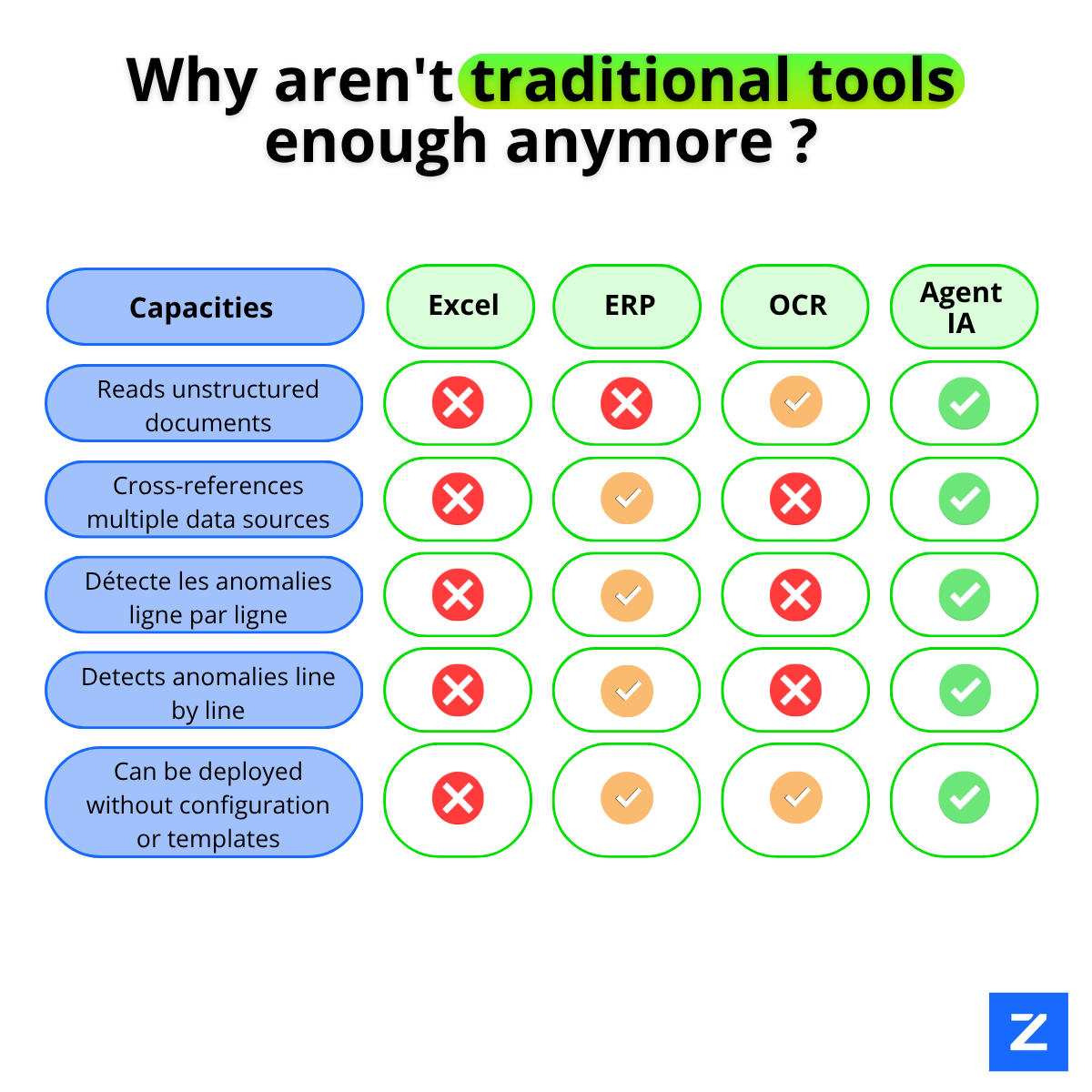
The ERP has, for several decades, been the backbone of procurement, finance and accounting departments. It centralises orders, tracks budgetary commitments and manages supplier payments. For these missions, it is irreplaceable. But faced with the reality of today's supplier data, heterogeneous, unstructured, multi-format, the ERP shows three structural limitations that are costly for organisations that have not yet taken the step of automation through AI agents.
An ERP only functions on data that has been pre-configured within it. Each new supplier requires several days of setup: coding of references, pricing conditions and validation rules. But the most underestimated cost is that of maintenance: as soon as a supplier modifies its format or conditions, the configuration becomes obsolete. The ERP then continues to validate invoices on the basis of outdated references, and discrepancies accumulate in silence until the audit.
The ERP is designed to process structured data according to its own reference framework. A supplier document that does not conform to that framework, meaning the vast majority of quotes, Unit Price Schedules, Price Breakdowns and invoices received in free format, cannot be used directly. It must first be re-entered, reformatted and matched to internal codes. This work systematically falls back on teams in the form of time-consuming manual tasks, a source of errors.
This rigidity has a direct effect on data quality: every manual re-entry is an opportunity to introduce an inaccuracy, a miscoded reference, a rounded discount or a simplified condition. The ERP then produces its analyses and payment validations on this imperfect data, without ever flagging the discrepancy with the reality of the supplier document.
The result is a well-known paradox: the ERP gives an impression of control. The data is entered, the flows are tracked, but this control is superficial. It does not detect that a discount has disappeared, that a price has been slightly modified, or that a billed service does not match the one ordered. The ERP records, it does not control.
The third limitation of the ERP is as much organisational as technical. Any adaptation necessarily goes through the IT department or the integrator. This incompressible delay between the need expressed by the business and its operational translation into the system can amount to weeks, sometimes months. In the meantime, teams continue to manually process what the system is not yet capable of absorbing.
This dependency creates a problematic asymmetry: procurement, finance and accounting teams identify the blind spots, but do not have control over the tools. They wait for an IT decision, a budget allocation, a slot in the roadmap, while billing discrepancies continue to accumulate every month.
This is precisely the friction that AI agents are designed to eliminate. An AI agent specialised in procurement data requires no prior configuration, no ERP integration, no specific development. It deploys in a matter of days and produces its first results within the first few weeks. Not as a replacement for the ERP, but as a complement: where the ERP records and tracks, the AI agent controls, compares and alerts.
Excel: the universal fallback reaching its structural limits
Faced with the ERP's shortcomings on unstructured documents, virtually every procurement department has developed the same reflex: the spreadsheet. Excel is flexible, accessible and familiar to everyone. For limited volumes and stable processes, it does the job. But as soon as document volumes increase and pricing conditions grow more complex, its structural limitations become apparent.
Excel compares numbers in cells, not contexts. It does not understand that a line labelled "handling included" corresponds to "free shipping" on the quote, does not verify whether a discount has been correctly applied to each relevant line, and does not automatically cross-reference an invoice with the current price list. Every verification remains manual, which means most of them simply do not happen.
Its second limitation is organisational: each team member builds their own file with their own logic. When they leave, the file becomes unreadable. There is no collective memory, no traceability of decisions. Excel is an individual tool in a process that involves multiple functions and multiple sites. And a formula error generates no alert, it propagates silently through every calculation that depends on it.
OCR: a useful first step, but an operational dead end
OCR solutions digitise documents and extract text, which is useful, but insufficient. They stop at the surface: they do not know that the unit price they have read needs to be compared against the price list negotiated six months earlier, do not detect that a different description refers to the same service, and do not understand that a VAT rate is incorrect. The extracted data lands in a spreadsheet that a team member must still analyse. OCR has shifted the problem, it has not solved it.
Agentic AI: turning documentary complexity into actionable intelligence
Agentic Artificial Intelligence represents a paradigm shift from all previous approaches, not because it is more powerful, but because it addresses the right problem. Contrary to a common misconception, AI does not thrive in creativity: it thrives in speed of detection and the ability to process heterogeneous documents at scale, without any predefined model.
Reading all formats, extracting the determining data
An AI agent trained on procurement numerical data uses natural language processing (NLP) and vision language models (VLM) to read a supplier document regardless of its format: a 400-line UPS in PDF, a manually laid-out Excel quote, an invoice generated from a supplier's ERP with proprietary codes. The agent extracts the determining data such as the nature of the service, quantities, unit prices, payment conditions and due dates, and classifies it logically, without manual entry.
Cross-referencing multiple frameworks simultaneously
Once the data has been extracted, the agent compares it simultaneously against all relevant reference frameworks: the original quote, the framework contract, the price list in force at the date of invoicing, the technical specifications for qualitative data, and the history of previous invoices to detect progressive drift. This cross-referencing extends to the content of the services: does the quantity delivered match the quantity ordered? Does the timeline respect the commitments in the specification document? The agent detects discrepancies that the human eye cannot see in the time available.
Alerting, documenting, acting
An effective procurement AI agent does not stop at detection. It alerts, it documents and it facilitates resolution. As soon as a discrepancy is identified, it can automatically generate an alert message to the supplier, with the precise contractual reference and the identified problematic line. It informs the relevant profit centres in real time. It simulates the impact of the discrepancy on margins and proposes renegotiation scenarios. It is this complete chain (reading, extraction, cross-referencing, detection, alerting) that transforms documentary complexity into a strategic lever.
Conclusion: supplier data, the first performance reserve you have not yet tapped
Most organisations look for their next performance gains in new negotiations, new suppliers, new markets. They overlook the fact that this reserve already exists, right before their eyes, in the documents that circulate every week between their teams and their suppliers: discounts not applied, overbilling not detected, contractual conditions ignored for lack of time to verify them, strategic decisions made without compared data.
This reserve is all the more accessible because it does not require renegotiating, changing service providers or launching a transformation project spanning several months. It requires a single change: giving your teams a tool capable of reading what your documents contain, cross-referencing what they reveal, and alerting on what is wrong in a matter of minutes, not days.
That is the promise of agentic AI applied to supplier data. Not to replace the expertise of your buyers, financial controllers and accountants, but to give back the time they currently spend on tasks that a machine does better and faster. So that they can finally focus on what truly creates value: supplier strategy, substantive negotiation, building lasting partnerships.
Today, 1 in 2 supplier documents still escapes control and analysis. Every uncontrolled document is a potential discrepancy that will never be detected, a margin that will never be recovered.
That is what ZYLIO promises to change. The AI agents that transform your supplier data into a performance reserve, deployed in a matter of days and with immediate ROI.
Discover ZYLIO !